Hour 010

This lesson is from SVS How to Draw Everything

This lesson is an intro to tone, what it does for your drawing, and how to add tone. This is just an intro where we practice basic concepts of using a technique like hatching to create depth to an object. The example is almost a little too simple, it doesn’t give you much opportunity to show how tone can help place objects in relation to others. It also doesn’t give you much to work with on local value. But, when this lesson comes up again, it would be good to create a ‘still life’ of basic shapes and then work on how to render tone. This will also be good to work in Photoshop.

Mechanical pencil and fine liner on letter size copy paper.

I spent 30 minutes total on this piece, short on time today.
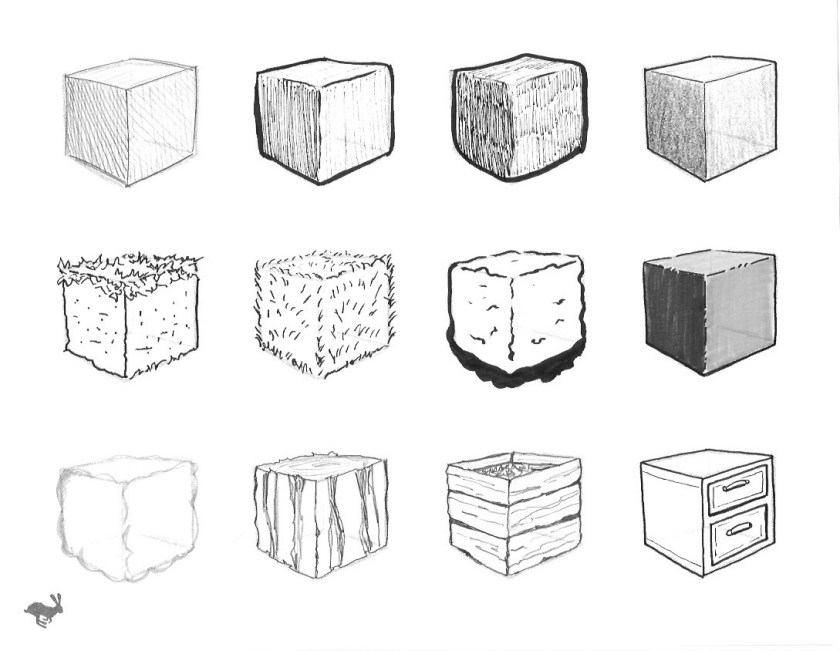
rows of boxes with linework and shading

Hour 009

This lesson is from SVS How to Draw Everything.

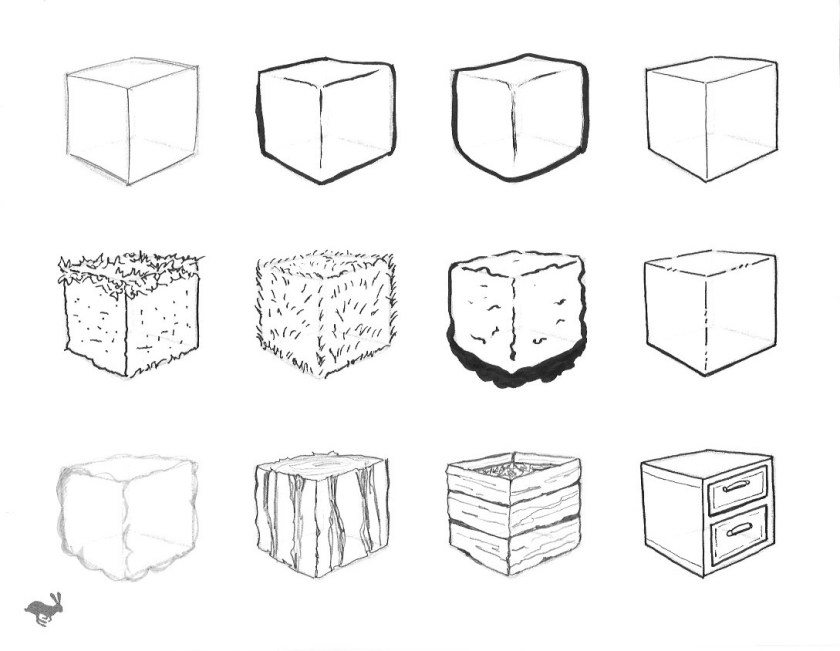
This lesson is about different types of lines and how they can help you to show the shape and texture of an object. It’s a quick easy lesson, but good to practice at coming up with different boxes to try to convey. It’s harder to show curved, fluffier lines, that might be something to keep working on – how to depict a cloud as a box? I should also use this exercise in Photoshop since doing it on paper is a little more simple. In Photoshop, I can work more on the gesture to structure to contour to detail line progression. I used the class handout for practice, but next time I should create my own shapes to use the line progression as part of the exercise.

Variety of pencil, brush pen, and fine liner on letter size copy paper class handout.

I spent 15 minutes practice and then 30 minutes to complete this image.

ink and pencil drawings of boxes

Hour 008

This lesson is from SVS How to Draw Everything.

This lesson is about trying to eyeball 3D shapes and how they can interact by combining them and cutting away pieces of them, all in estimated perspective. This was a harder lesson so far, so most of my hour was watching the videos and following along with the demos of how to draw the shapes. This is about 3 pages of notes and examples that I will reduce to single practice pages in the future. The concept of combining shapes and finding intersections is still new to me and harder to grasp. I was working on the same concept in Draw A Box Lesson 2, but this is more clear since you are working on only one shape at a time, and keeping things on the same plane to begin with. It’s still challenging however. I’ll look forward to repeating this one again soon. I’ll mark it has Hard to repeat it sooner.

Col-erase pencil in 9×12 sketchbook.

I spent the full hour working through the lesson videos and working the examples.

sketches of 3D shapes from a class lesson

Hour 007

This lesson is from SVS How to Draw Everything.

This lesson is about estimating shapes in perspective. Some other lessons I am taking use rulers to draw or to verify that the lines correctly map to the vanishing points. This lesson is about estimating or eyeballing the shapes in perspective. It’s part of the idea of getting the muscle memory into practice so you can better guess how things will look and draw them. This way you can focus on what you are drawing instead of how you are drawing it. The basic shapes and 1pt perspective is fairly easy for me, but the two point perspective is a little harder, I make some mistakes as I go. This is a great warmup exercise and will be really good to do in Photoshop next time I work on it. This is also a good ‘doodle’ exercise to do when watching videos or listening to a podcast.

Ball point pen on letter size copy paper.

I spent 30 minutes practice and then 30 minutes to complete this image.

sketches of simple shapes in 1 and 2 point perspective

Hour 006

This lesson is from this Draw A Box, Lesson 2.

This lesson is about stacking and intersecting organic shapes in the form of sausages. I did this lesson for the first time a few days ago and struggled with the concept. This time I got closer to understanding it! I did a 30 minute practice using different colors of ballpoint pens. I also worked on one intersection between two objects. This really helped understand how the forms could intersect. It also let me see the forms more clearly in my mind. One thing that helped was actually having one form grow out of another. Then I could see the depth and shape of the 3D form. This was very useful. I know the instructions say to pile things up, then figure it out and it’s ok to be wrong. But, for me, it’s easier to do practice on simple pairs of shapes using two different colors, then I could get the concept first.

This completes Lesson 2 of Draw A Box and I’ll turn my work in asap.

Fine liner on letter size copy paper.

I spent 30 minutes practice and then 30 minutes to complete this image.

a drawing of a pile of sausages